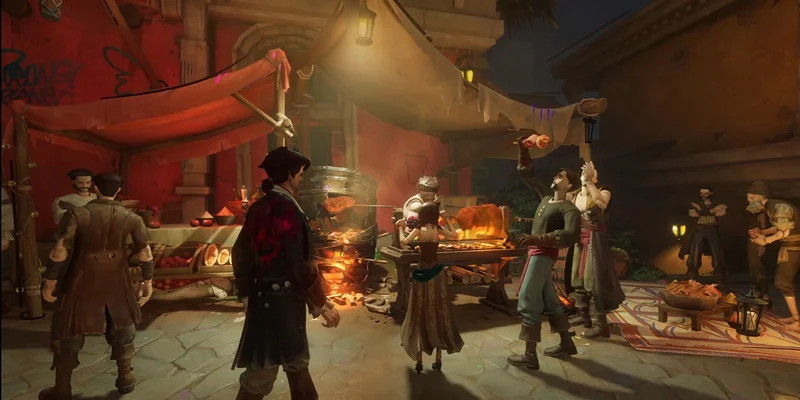
- Sea of Remnants ship battle rewards movement, spacing, and careful target selection.
- Start with positioning before committing to an attack or chasing an enemy.
- Use open water to create room for turning, retreating, and regrouping.
- Treat beta information carefully because combat behavior may change during testing.
- Review every encounter to improve steering, timing, and risk assessment.
Sea of Remnants ship battle basics
Sea of Remnants ship battle is a movement-focused combat activity within the game’s broader ocean adventure. The available 2026 beta footage presents a fantasy seafaring experience with open-water exploration, ship encounters, and active combat. Because the game is still in a testing phase, this guide focuses on reliable combat principles rather than unannounced statistics, fixed builds, or final balance claims.
The most important skill is reading the battle space. A ship that turns too sharply, follows an enemy into an unsafe area, or commits without an escape route can lose control of the encounter. Strong play begins before the first attack: identify nearby threats, keep enough water around your vessel to maneuver, and decide whether the goal is damage, escape, or repositioning.
Video Highlights:
- Open-world sailing and ocean exploration
- Ship-to-ship combat encounters
- Movement and turning during active battles
- A practical look at the 2026 beta presentation
| Combat priority | Why it matters | Practical habit |
|---|---|---|
| Positioning | Creates room to attack or disengage | Avoid fighting with obstacles or threats directly behind you |
| Movement | Controls distance and approach angles | Make deliberate turns instead of constant sharp corrections |
| Target focus | Prevents wasted pressure | Select one immediate threat before changing direction |
| Escape planning | Limits avoidable losses | Keep an open route before entering a risky exchange |
Control the Space
Maintain enough water around the ship to turn, retreat, and change approach angles without panic.
Choose the Moment
Attack when your ship is stable and your target is readable, not while correcting a poor approach.
Protect the Exit
Before committing, identify where you will move if the encounter becomes unfavorable.
Treat every encounter as a positioning test first and a damage test second. A safe angle gives you more options than an early attack.
A step-by-step battle flow
A repeatable battle routine helps reduce rushed decisions. The exact controls, damage values, and ship systems may continue changing during the 2026 closed beta, but the sequence below remains useful for learning the visible rhythm of an encounter.
Scan the water
Before closing distance, look for the target’s movement direction, nearby hazards, and enough open water to complete a turn. Do not enter an engagement without knowing your likely retreat path.
Set your approach
Move into a position that gives you time to react. A shallow approach is usually easier to correct than a direct rush because it leaves more room for steering adjustments.
Commit briefly
Apply pressure during a short, controlled exchange. Avoid staying locked into one direction if the target begins changing course or if another threat enters the area.
Reposition
After the exchange, create distance or alter your angle. Use this moment to regain control rather than immediately repeating the same approach.
Decide whether to continue
Continue only when the battle remains manageable. If your position worsens, disengage, recover your bearings, and return from a safer angle.
| Battle phase | Main question | Recommended response |
|---|---|---|
| Approach | Can I turn away safely? | Slow the commitment and preserve open water |
| First exchange | Is the target still predictable? | Continue briefly if the angle remains favorable |
| Reposition | Did my angle become unsafe? | Create distance and reset the engagement |
| Decision point | Is another threat involved? | Prioritize survival and avoid tunnel vision |
Do not treat one 2026 beta encounter as proof of final balance. Damage, steering, enemy behavior, and encounter pacing can change before wider release.
Positioning, steering, and target control
Ship combat becomes easier when movement has a purpose. Instead of steering continuously, assign each turn a goal: close distance, open distance, pass an enemy, or prepare an escape. This prevents overcorrection and makes the ship’s direction easier to read.
When approaching a target, avoid placing your vessel in a position where the next turn is impossible or heavily restricted. Open water is valuable because it lets you choose the next engagement angle. If the target moves unpredictably, widen the gap rather than forcing a close exchange that you cannot control.
Target selection also matters. A nearby threat may not always be the best target if another enemy is already blocking your route. Prioritize the opponent that threatens your movement, escape lane, or ability to regroup. This approach is more reliable than focusing only on the enemy with the lowest apparent resistance.
Close Distance
Use when the target’s movement is readable and your ship has room to turn after the approach.
Open Distance
Use when the enemy’s direction is uncertain or your current angle limits safe movement.
Change Targets
Use when another threat controls your escape route or makes the current exchange unsafe.
| Positioning problem | Common mistake | Better correction |
|---|---|---|
| Too close | Turning after the enemy has already passed | Begin the turn earlier and preserve reaction time |
| Too far | Chasing in a straight line without a plan | Adjust the approach angle before committing |
| Limited escape route | Entering combat near threats or obstacles | Move into open water before attacking |
| Multiple threats | Focusing on one target too long | Choose the threat that restricts movement first |
Open water is not empty space; it is a combat resource. Preserve it whenever you expect the encounter to last more than one exchange.
Preparation and practice checklist
The best early preparation is not a complicated build. It is a consistent process for learning movement, recognizing danger, and reviewing mistakes. Since the available material does not confirm final ship statistics or a complete equipment system, avoid planning around unannounced numbers.
Use short practice sessions. Focus on one skill at a time, such as maintaining a clean approach, completing a controlled turn, or disengaging before the encounter becomes chaotic. This makes improvement easier to measure than attempting to master every combat decision at once.
Before Your Next Encounter:
- Identify open water and a possible retreat route
- Choose one primary target before committing
- Approach with enough distance to correct your direction
- Reposition after each exchange instead of repeating automatically
- Record which steering decision caused the encounter to worsen
| Practice goal | What to observe | Success indicator |
|---|---|---|
| Steering control | How early you begin each turn | The ship reaches the intended angle without panic corrections |
| Distance control | When the target becomes difficult to read | You can close or disengage deliberately |
| Target discipline | Whether attention shifts too often | One clear threat remains the focus during each exchange |
| Risk management | Why you continue or retreat | Your decision matches the available escape space |
Improvement is visible when you can explain why you entered, continued, repositioned, or retreated from an encounter.
2026 beta expectations and FAQ
Sea of Remnants remains in a pre-release testing period in 2026. The site’s current game identity describes a fantasy ocean RPG centered on sailing, party combat, and building the pirate city of Orbtopia, while the available gameplay material highlights open-water travel and ship encounters. Exact final systems, balance values, and launch behavior should be confirmed through official channels as testing develops.
The Dawnbreaker Closed Beta is scheduled to begin on December 3, 2026. Beta access and observed combat behavior should be treated as testing information rather than a guarantee of the finished game.
| Information type | 2026 status | How to use it |
|---|---|---|
| Ship battle footage | Available in beta gameplay material | Study movement and encounter pacing |
| Final combat balance | Not confirmed | Avoid fixed damage or tier claims |
| Closed beta | Begins December 3, 2026 | Check official access details before relying on eligibility |
| Full launch details | Not part of this guide’s confirmed 2026 data | Follow official announcements for updates |
Q: What is the main goal in Sea of Remnants ship battle?
The immediate goal is to control the encounter: maintain a useful position, pressure a target when the angle is favorable, and retreat when the battle becomes unsafe.
Q: Should I always stay close to an enemy ship?
No. Distance should serve a purpose. Close distance when the target is readable, but create space when your angle, escape route, or steering control becomes poor.
Q: Are the ship battle mechanics final in the 2026 beta?
No. The game is still in testing, so steering, damage, enemy behavior, and encounter pacing may change before the finished release.
Q: When does the Dawnbreaker Closed Beta begin?
The current site information lists the Dawnbreaker Closed Beta for December 3, 2026. Confirm access requirements through official Sea of Remnants channels.
Build your first 2026 beta sessions around observation rather than speed. Learn how the ship turns, how targets move, and when open water gives you the safest reset.
Related Sea of Remnants Guides
Continue with these Sea of Remnants guides: