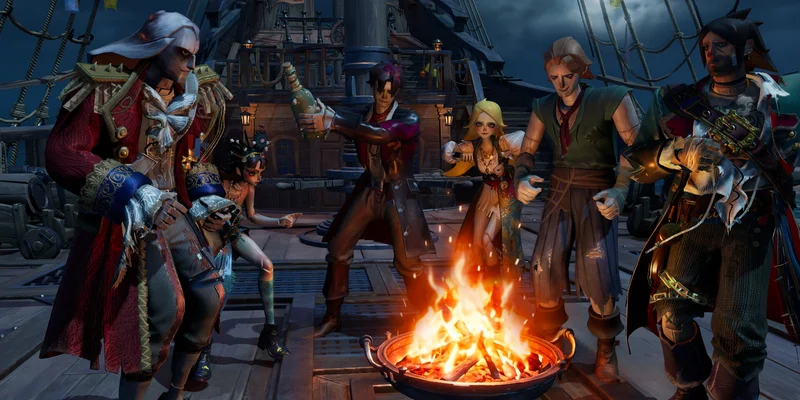
- Sea of Remnants characters are currently best tracked through confirmed voice lines and visual references.
- Character names are not established by the available reference material, so avoid treating archetypes as official identities.
- Combat signals include healing, storm attacks, firearms, experiments, prophecy, and heavy impact abilities.
- Roster tracking works best when you separate confirmed details from interpretation and test-period observations.
- Video reference: The available compilation is useful for comparing voice delivery, attack calls, and personality cues.
Sea of Remnants Characters: What Is Confirmed
Sea of Remnants characters are presented through a broad collection of battle calls, personality statements, and dramatic introductions. The available character compilation includes lines associated with targeting, healing, storm powers, medicine, prophecy, experimentation, leadership, and explosive attacks. However, it does not establish a complete official roster with names, classes, statistics, or faction labels.
That distinction matters when building a fan wiki page. A line such as “Captain’s here” suggests a leadership persona, while “Medicine treats the body” suggests a support or medical identity. These are strong character signals, but they should remain labeled as archetypes until official names and descriptions are published.
Video Highlights:
- Character introductions use distinct combat personalities and delivery styles.
- Several lines suggest support, damage, control, leadership, and experimental roles.
- Storm, medicine, prophecy, and explosive motifs provide useful sorting categories.
- The compilation should be used for identity tracking, not as proof of unreleased statistics.
The strongest confirmed information is the language itself. Several lines indicate that the roster is designed around memorable combat identities rather than generic soldier roles. The speaker who says “We ride the storm” creates a different impression from the character declaring “Need more boom,” even though neither line confirms a formal class.
| Confirmed signal | What it supports | What it does not prove |
|---|---|---|
| “Captain’s here” | Leadership or command persona | Official captain class or faction |
| “Medicine treats the body” | Healing or medical theme | Exact healing skill or recovery value |
| “Storm coming” | Weather or storm-based combat identity | Element type, damage, or cooldown |
| “Let me check my book” | Scholarly, prophetic, or analytical persona | Spell system or passive ability |
| “Need more boom” | Heavy-impact or explosive identity | Weapon type or damage ranking |
Do not assign names, rarity tiers, statistics, or official classes to unnamed speakers. Use labels such as “storm-themed archetype” or “medical support signal” until the game provides clearer roster information.
Character Archetypes and Combat Signals
The available lines support several practical archetypes for organizing Sea of Remnants characters. These categories are not a formal tier list. They are a research framework for recognizing how a character may function or how the game may present that character’s identity.
A useful roster guide should track both combat language and personality language. Combat language describes what a character appears ready to do, such as targeting, healing, shooting, or calling a storm. Personality language describes how that character approaches conflict, including confidence, grief, humor, authority, or uncertainty.
Storm Vanguard
- Uses weather and movement imagery
- May emphasize momentum or area pressure
- Strong visual identity for team-building notes
Field Medic
- Centers medicine, pain, or recovery
- Likely support-oriented in presentation
- Avoid assuming exact healing mechanics
Heavy Striker
- Focuses on impact, explosions, and direct attacks
- Clear aggressive combat language
- Damage ranking remains unconfirmed
Oracle Researcher
- Uses prophecy, books, revelation, or experiments
- Suggests analysis or unusual abilities
- Role and faction are not officially established
The “Field Medic” signal is among the clearest support themes because the lines directly reference medicine and pain. The “Storm Vanguard” category is more thematic, built around phrases such as “storm coming” and “we ride the storm.” The “Heavy Striker” category uses aggressive phrases including “ready for a beat down” and “need more boom.”
| Archetype | Strong language cues | Likely wiki tag | Confidence |
|---|---|---|---|
| Field Medic | Medicine, body, pain | Support, Recovery | High thematic signal |
| Storm Vanguard | Storm, ride, follow me | Area Pressure, Mobility | Medium thematic signal |
| Heavy Striker | Boom, big one, beat down | Burst Damage, Impact | Medium thematic signal |
| Oracle Researcher | Prophecy, revelation, book | Control, Utility, Knowledge | Medium thematic signal |
| Captain Leader | Captain, future, follow me | Command, Team Utility | Low to medium signal |
Use these categories to organize notes, not to create unsupported character pages. A fan wiki can safely document a recurring voice motif while waiting for official portraits, names, or ability descriptions.
Use two separate fields in every character entry: “Confirmed voice or visual signal” and “Possible combat interpretation.” This keeps useful analysis available without presenting speculation as canon.
How to Track Unnamed Characters
Character identification becomes easier when every line is logged consistently. The goal is not to guess a name immediately. The goal is to create a stable reference record that can be updated when official information appears.
Capture the Exact Line
Record the spoken phrase exactly, including unusual wording such as “The real stage? It’s in my dreams” or “This is the end of the old era.” Avoid rewriting the line into a stronger claim.
Tag the Combat Theme
Assign one or two temporary tags, such as healing, storm, firearm, prophecy, leadership, experiment, or explosive attack. Keep tags descriptive rather than definitive.
Separate Personality From Ability
Mark whether the line reveals attitude, story context, or a possible combat function. A dramatic statement may establish personality without confirming a skill.
Compare Repeated Motifs
Look for recurring patterns in delivery and vocabulary. Repeated references to storms, medicine, or research may help group lines that belong to the same character identity.
Update Only With Confirmed Information
Add an official name, role, or ability when it is published through a reliable game channel. Preserve earlier notes as provisional observations instead of deleting them.
| Tracking field | Example entry | Status |
|---|---|---|
| Temporary label | Storm voice A | Provisional |
| Exact quote | “We ride the storm.” | Confirmed line |
| Theme tag | Storm, mobility | Interpretive tag |
| Personality cue | Confident, rallying | Interpretive tag |
| Official identity | Not announced in available material | Unconfirmed |
This workflow is especially helpful for a pre-release title, where dialogue may appear before a complete character database. It also reduces duplicate pages caused by treating every attack call as a separate confirmed character.
Treat all early character observations as pre-release or test-period notes. Recheck them against official updates before creating rankings, build recommendations, or permanent roster categories.
Personality Themes in the Character Roster
The dialogue suggests that the roster is built around contrasting emotional tones. Some characters sound disciplined and professional, while others are playful, theatrical, mournful, prophetic, or openly aggressive. These tones can help readers recognize characters even before names are easy to remember.
Professional delivery appears in lines such as “Target neutralized,” “Requesting confirmation,” and “Deviation detected.” These phrases suggest characters who approach conflict through procedure, precision, or analysis. In contrast, “Feeling lucky?” and “Get a load of me” signal confidence and showmanship.
Several lines also introduce emotional stakes. “For the fallen,” “I burn. Burn with you all,” and “Forgive me. It must be done” suggest grief, anger, or reluctant duty. These lines may be tied to character backstories, but the available material does not confirm the events behind them.
| Personality theme | Representative signal | Reader-facing description |
|---|---|---|
| Tactical | Target confirmed, deviation detected | Precise and mission-focused |
| Theatrical | Real stage, graceful salute | Dramatic and performance-driven |
| Defiant | Shatter the old world | Confrontational and revolutionary |
| Compassionate | You are not alone | Protective or reassuring |
| Haunted | For the fallen, forgive me | Motivated by grief or duty |
| Playful | Feeling lucky, get a load of me | Confident and lighthearted |
This emotional range is valuable for SEO because many readers search for characters by memorable quotes rather than official names. A well-structured wiki can support both approaches by using quote-based tags temporarily and replacing them with canonical names later.
Quote Recognition
Search memorable lines such as “You’re not alone” or “Storm coming” when a name is unknown.
Tone Matching
Compare delivery styles: tactical, theatrical, mournful, playful, or prophetic.
Lore Caution
Treat emotional lines as clues, not confirmed backstory summaries.
A strong character page can be useful before every detail is known. Label the page clearly, preserve exact quotes, and update the identity section when official information becomes available.
Character Research Checklist and Reference Notes
Use the following checklist when cataloging the roster or reviewing a new character compilation. It is designed for accuracy rather than early ranking claims.
Character Documentation Checklist:
- Record the exact voice line without changing its meaning
- Add temporary tags for combat theme and personality
- Separate confirmed details from interpretation
- Avoid assigning names, classes, stats, or rarity without a reliable source
- Mark pre-release or test-period observations with the correct date
For current availability and official test notices, readers should check the Sea of Remnants Steam page as a primary reference, checked November 10, 2026. Use official announcements to confirm whether a character, voice line, or ability has moved from promotional material into the test build.
| Research question | Safe answer format |
|---|---|
| What is the character’s name? | Confirmed name or “not announced” |
| What role does the character play? | Official role or “possible support/attack signal” |
| Is the character playable? | Confirmed playable, test-period appearance, or unknown |
| Is the character strong? | Avoid ranking until version and data are available |
| What does the quote reveal? | Describe tone or theme without inventing lore |
Avoid publishing a conventional S-tier list from voice lines alone. A character who says “Here’s a big one” may sound powerful, but the phrase does not establish damage, range, cooldown, or team value. Similarly, a medical line does not prove that the speaker is the best healer.
Q: Are the Sea of Remnants characters officially named in the available material?
Not all of them. The available character compilation provides voice lines and identity cues, but it does not establish a complete official roster with names, classes, or statistics.
Q: Can the voice lines confirm a character’s class?
They can suggest an archetype, such as Field Medic, Storm Vanguard, or Heavy Striker. They should not be treated as proof of an official class until the game or its official channels confirms it.
Q: Which character theme appears most clearly?
The medical support theme is particularly direct because several lines reference medicine, the body, and pain. Storm, prophecy, leadership, and explosive themes are also prominent but remain interpretive categories.
Q: Should players use these observations for a tier list?
No. Voice lines are useful for recognition and personality tracking, but they do not provide enough evidence for rankings. Any future tier list should include a version, test status, and reliable gameplay data.
Do not turn personality, voice delivery, or dramatic attack calls into power rankings. A reliable tier list requires confirmed abilities, testing conditions, and a clearly labeled 2026 version.
Related Sea of Remnants Guides
Continue with these Sea of Remnants guides: